Tomorrow is Christmas 2015! Merry Christmas all.
Weirs are the least expensive permanent measurement device you can install. Materials will cost the diverter in the range of $300 to $2,000; hiring the backhoe to set it in place probably costs more than the materials, unless the diverter already has a backhoe or crane.
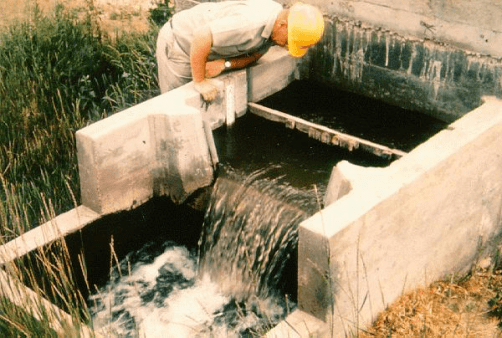
The weir below was precast by Briggs Manufacturing in Willows. The weir is a cast concrete, 3-sided box with board slots for 2″ lumber. It’s pretty simple, and relatively easy to install. This particular weir needed metal wing-walls to keep the dirt on the sides from washing out. Note that there are two board slots on each side, one for the boards to slide in, and the other to help make sure a nappe or air gap is created as water flows over the boards.
Step one is determining if there is enough fall in head from upstream to downstream. A weir needs 0.7 feet (0.7′), or 8.4 inches (8.4″) of fall to be sure it will work correctly. The 0.7′ figure is because the pool of water needs to be a maximum of 0.45′ above the top of the weir boards on the upstream side. Then, the water in the ditch downstream of the weir needs to be at least 0.25′ below the top of the boards so the water flows freely, separating from the boards and having an air gap on the downstream side. 0.45′ + 0.25′ = 0.70′.
The photo above shows a ruler in tenths of a foot, held vertically on top of the weir boards. This is called “sticking the weir”. When the ruler is turned face-on to the flow, the water will climb up to the same level as the flat pool upstream of the boards. It’s physics – standing water has an energy level equal to the height of the water surface. Moving water has both potential and kinetic energy, so the energy level or line is above the surface of the
 water. Moving water stalls behind the face of the ruler, giving the height of the water if it were standing still. That is the water depth that has to be measured for weirs. The photo is showing a water level of 0.31′ – it wobbles up and down just a little – so we know this weir is flowing at about 0.6 cfs per foot of width.
If the ditch is very flat and shows no ripples when flowing, it’s probably too flat, and an orifice or a flume will be needed instead of a weir. Future posts will discuss those measurement devices, and others too.
Step 2 is figuring out how big a box is needed. Fortunately, there is an easy rule. 1.0′ feet of width is needed for every cubic foot per second (cfs) that will be diverted. For example, if the diversion will be a maximum of 3 cfs, then the diverter will need a 3′ wide weir. If in doubt, get the next larger size since the cost is not much more. The reason for this rule is that a weir can be accurate to plus or minus 5%, well within the accuracy needed for diversions in the field. If the pool upstream of the weir boards is more than 0.45′ over the top of the boards (or less than about 0.1′ over the top of the boards), the accuracy of the weir is worse than the standard.
Measurement devices need to be planned and operated correctly to assure the diverter (and ditch-tender, and neighbors, and the State Water Resources Control Board, and possibly 10 other state and federal agencies, and possibly even the Superior Court in the very worst case) that the flow measurement is correct. It’s like a truck speedometer – they can get less accurate over time. It’s no problem if they read faster than the driver is actually driving, but if they read slower, the driver is in danger of unknowingly speeding and getting a ticket. Ouch.
The actual installation process is fairly simple to describe. Get 1 to 4 yards of 3/4″ minus road base rock delivered on site, trucked from the gravel plant. To save a lot of hassle, skip the forming up and pouring a concrete weir, and just call Briggs Manufacturing and order a weir to be delivered on site. Dig a shallow, level (flat), square hole in the bottom of the ditch, about 8″ deep, and 1′ longer and wider than the bottom of the weir. Shovel base rock into the hole about 2″ deep, and compact it. Rent a gas-powered thumper, or use the bucket of the backhoe. Pour another 2″ and compact it. Use a level and make sure the top of the base rock is level side to side, and along the ditch. Since it packed down during compacting, add the last 1″ and compact it, so the top of the road base is about 4″ below the bottom of the ditch upstream and downstream.
The installer needs to make sure to have a piece of 1″ steel bar that is about 1′ longer than the the width of the weir box. There is one hole through the top of each side of the weir – stick the rod through that and hook onto it with a chain to lift the weir. Set it in place, and make sure it is sitting level. The installer might have to gently press down on one side with the backhoe to get it completely level. Now the floor of the weir will be at the level of the bottom of the ditch. Remove the steel bar, and fill the weir box inside about 2′ deep with some dirt.
Next, install the wing-walls, if needed. These will keep the material on the outsides of the weir from washing out in a steeper ditch. Then backfill with the remaining road base on the sides, compacting it for each 6″ of depth. If t he native soil holds water well, it could be used instead of base rock to backfill, saving a little bit of money. Remember the dirt that was placed 2′ deep inside the weir? This will keep the weir weighted down so it does not move during backfilling. Also, it will keep the sides from being slightly bent in by the pressure of compacting the backfill. The reinforced concrete weir boxes are strong but the walls can be bent in with enough force.
That’s it! The weir box is installed and ready to go. New weir boards, usually 2″ x 6″ or 2″ x 8″, should be cut about 1″ shorter than the width inside the board slots. For example, a 3′-wide weir will have board slots about 2″ deep. The full width from inside of board slot, to inside of the opposite board slot, is 3′-4″. The boards should be cut about 3′-3″ long. That way, when they swell a little bit, they won’t get impossibly stuck.
Happy measuring! Good night to all, Merry Christmas, and blessings in the New Year.


 ever measured flow into a ditch before, well, here goes, I am going to leak the secrets right here, I’m going to violate the Unspeakable Code Of The Water Measuring Brotherhood, the ve